Across wholesale, foodservice, and import distribution, repeat B2B orders rarely arrive through a clean portal checkout. Restaurant managers, clinic buyers, and store leads send quick WhatsApp messages between shifts: shorthand names, a shelf note photo, or a voice message ending with "same as Tuesday, plus two extra crates." When sales staff manually decode those messages and rekey each line into the ERP, bottlenecks shift from winning accounts to fixing pack-unit errors, missed cutoffs, and backorder surprises.
Illustrative synthetic scenario: the examples in this article describe architectural patterns for business WhatsApp AI agents and do not represent a specific customer deployment, live ERP inventory state, or performance guarantee.
Why Informal B2B WhatsApp Orders Break Generic Chatbots
Many distributors first try pushing repeat buyers onto a web portal, or wire an unconstrained prompt directly to WhatsApp. Both paths hit the same reality: buyers pick WhatsApp because it takes seconds on a busy floor, yet their shorthand rarely matches formal ERP item descriptions.
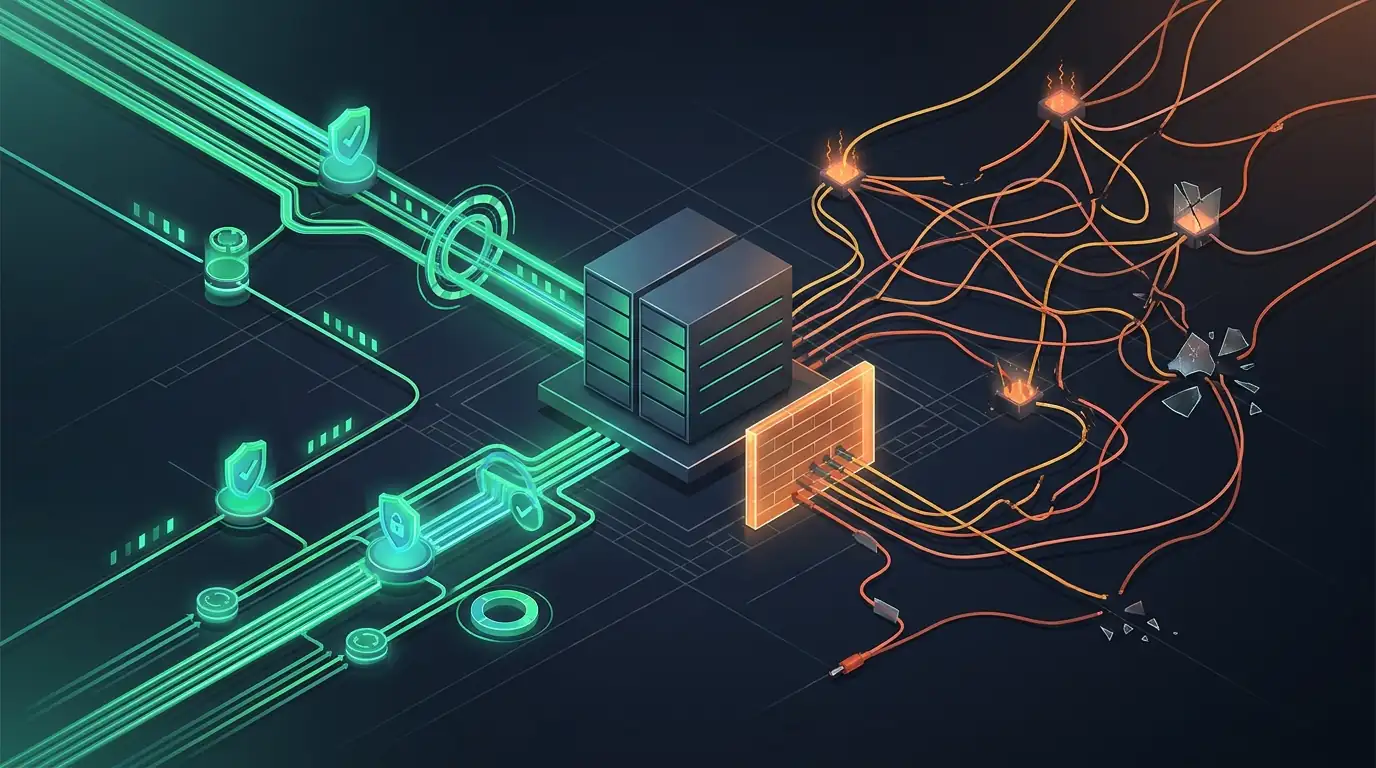
Guessing SKUs and writing unverified lines. A raw language model infers item names, confuses single units with master cartons, and replies without checking contract pricing, credit holds, or allocatable stock.
Account-scoped matching, deterministic unit math, and ERP staging. The agent verifies the sender, resolves buyer shorthand against prior orders, checks pack rules and stock in deterministic code, and writes a reviewable draft.
The hard problem behind a wholesale order intake agent is never generating polite replies. It is enforcing strict operational rules behind natural conversation: customer-specific price lists, full case multiples, route cutoffs, and the line between temporary out-of-stock SKUs and discontinued products.
Four-Stage Pipeline From WhatsApp Message to Staged ERP Draft
Reliable WhatsApp ERP AI integration separates conversational parsing from pricing, inventory, and ledger writes. Rather than letting a language model construct unrestricted database mutations, inbound requests move through four controlled stages orchestrated by business workflow agents:
- Verified sender identity and contract scope: The official WhatsApp Cloud API webhook matches the sender phone number against authorized contacts on the buyer account. Every downstream query runs scoped exclusively to that account's approved catalog, contract tier, and historical order baseline.
- Line extraction and deterministic pack-size math: The model extracts requested items and quantities from text or transcribed voice notes, then matches each line against the buyer's SKU crosswalk and past purchases. Carton conversions, minimum order quantities, and case-multiple rules execute strictly in deterministic code rather than model arithmetic.
- Allocatable inventory and route cutoff checks: For every matched SKU, the workflow queries real allocatable stock in the ERP (excluding units already committed to open orders) alongside the buyer's delivery zone and dispatch cutoff time.
- ERP draft staging and structured confirmation: Cleanly resolved lines write to a draft sales order tagged with the inbound WhatsApp message ID, followed by a concise summary sent back to the buyer with structured interactive confirmation buttons.
Illustrative Scenario: Morning Restock Message From a Repeat Buyer
Consider an illustrative foodservice distributor receiving a WhatsApp message at 07:15 from an authorized restaurant contact (synthetic account B-204): "Morning, send us for tomorrow: 3 olive oil tins, 4 crates mozzarella, 6 napkins, and espresso cups if back in stock." At first glance this looks like four simple lines, yet each line triggers a distinct deterministic check:
- Olive oil and mozzarella crates: Order history shows account B-204 consistently buys one specific five-liter olive oil tin and a six-kilogram mozzarella case. Both items have allocatable stock for tomorrow's route and enter the draft order immediately.
- Ambiguous pack quantity on napkins: Asking for "6 napkins" leaves open whether the buyer wants six inner sleeves or six master cartons, while the catalog sells that SKU strictly in eight-pack cartons. Instead of guessing, the agent flags the quantity for clarification using two explicit WhatsApp quick-reply options.
- Out-of-stock check on espresso cups: The regular SKU remains out of stock at the central warehouse. Deterministic lookup checks the distributor's pre-approved substitute table, finds an available cup SKU matching capacity and material, and offers it as an explicit buyer choice rather than inserting a silent replacement.
Illustrative workflow decision: handling clean lines, pack ambiguity, and an out-of-stock SKU in one message
The intake agent writes the confirmed olive oil and mozzarella lines to a draft order so route allocation is preserved, then replies with a single structured message showing the staged lines, interactive pack-unit choices for napkins, and a yes/no option for the substitute espresso cups. One unclear line never blocks the rest of the order or triggers a silent fulfillment mistake.
Security, ERP Write Boundaries, and Human Handoff
ERP systems hold sensitive customer pricing, credit terms, and financial postings. Exposing unconstrained ERP write endpoints directly to a language model introduces severe security and accounting risks. That is why B2B WhatsApp order automation belongs on an official WhatsApp Cloud API gateway backed by durable queues and role-scoped server tools, following the same authorization discipline we apply in custom AI CRM architectures with MCP.
Non-negotiable permission boundary: Every inbound message, voice note, or handwritten shelf photo is treated as untrusted input. The agent cannot read other customer accounts, cannot override contract prices, and cannot promote a draft order past credit limits or unresolved billing blocks.
Equally important is defining the exact moments where automation stops trying to resolve an edge case and hands the thread to a human account rep with the partial draft already prepared:
- Custom discounts or uncatalogued requests: Any request for special pricing, new product sourcing, or sample trials routes straight to the assigned sales rep while keeping verified lines intact in the draft.
- Credit holds and overdue account flags: When the ERP returns a credit block, the agent avoids exposing sensitive financial details in chat, informs the sender that their account rep is reviewing the request, and opens an internal handoff task.
- Unrecognized sender numbers or unreadable photos: Messages arriving from phone numbers not linked to an authorized B2B contact never gain access to wholesale catalogs or account history and route directly to customer support verification.
Rollout Checklist for Importers and Wholesale Distributors
When scoping custom AI engineering for business operations, rollout reliability depends on preparing catalog metadata before prompts. Five checks keep production predictable:
- Build an alias dictionary from past chats: Audit recent buyer WhatsApp threads to map shorthand and bilingual transliterations to canonical ERP SKUs.
- Clean unit-of-measure rules in the ERP master: Verify base units, inner packs, case multiples, and minimums match warehouse picking units.
- Launch in draft-only mode first: Stage ERP drafts for one-click coordinator approval before enabling automated confirmation on repeat lines.
- Encode cutoffs and substitute rules in tables: Keep route deadlines and approved swaps in deterministic configuration rather than long prompts.
- Retain message-to-line lineage: Store the WhatsApp message ID on every staged ERP line so operations can verify customer phrasing in seconds.
Successful B2B WhatsApp order automation meets buyers where they already communicate.
Pairing account-scoped catalog matching with deterministic pack math, live stock checks, and staged ERP drafts eliminates manual rekeying errors and frees staff for exceptions and account growth.