Businesses
Invoicing, expenses, purchasing, stock, people and the ledger in one workspace, with documents for 39 countries. Several businesses can sit under one login, each with separate records.
Guliel is accounting and finance-operations software, built in Singapore. Customers, suppliers, invoices, expenses, people, time and a double-entry ledger share one data model, so you can start beside the tools you have and move over when you are ready. A DevShift product.
Free to sign up · per organization, not per seat · documents for 39 countries · double-entry ledger
Who it's for
Guliel treats the spread of finance tools as a data-model problem. Customers, suppliers, people, documents and the ledger sit in one model, so one record carries through from the customer to the invoice to the books.
Invoicing, expenses, purchasing, stock, people and the ledger in one workspace, with documents for 39 countries. Several businesses can sit under one login, each with separate records.
Every client organization under one login, with a role on each. Only a manager approves a captured expense into the ledger or moves the lock date, and the same roles apply to people and AI. Guliel prepares the records; the accountant reviews, approves and files.
Automations, the REST API, the in-app AI companion and any MCP client, such as Claude, ChatGPT or Copilot, work on the same records within the user's role.
How it works
Start beside the tools you have. Import a Morning export, the Israeli uniform file or a customer spreadsheet, and export the ledger as CSV whenever you need it. Connectors for QuickBooks, Xero and other tools are planned.
Automations run the routine steps: a receipt on payment, overdue reminders, a reorder when stock runs low, scheduled reports. A captured expense still waits for a person's approval before it reaches the ledger.
Tax reports by period have adapters for Israel, Singapore and the USA. Israeli allocation numbers through SHAAM and Guliel's own Peppol access point are built but not switched on, so documents are PDF today. Guliel does not file returns.
Invite a supplier by email. When it accepts with its own Guliel organization, the two are linked, and it sees your purchase orders and invoices against them. Direct document exchange, supplier discovery and B2B payments are planned.
Capabilities
A fixed chart of 17 accounts, journal entries that must balance, a books lock date and CSV export. The ledger posts from the same document lines as receivables and payables, and 49 report definitions include the trial balance, balance sheet, income statement and cash flow. Custom accounts are planned.
Invoices, receipts, invoice-receipts, payment requests, credit memos and debit memos as PDF, in English, with Hebrew for Israel and Thai for Thailand. Numbers are allocated at issue, and recording a payment issues a receipt.
Phone scans with OCR, and bills captured from Gmail, Outlook, IMAP and POP3 inboxes. AI suggests a category from your own list, and a manager approves each expense before it reaches the ledger.
Employee records, leave, and attendance with clock-in and timesheets work in every country. Salaries and ID numbers are visible to managers only. Singapore payroll calculates CPF, SDL, FWL and self-help group funds and posts payslips to the ledger. Payroll for other countries is planned.
One record per business, whether it buys from you or sells to you. A purchase order links to the supplier's invoice, and a low-stock movement can start an automation.
A REST API with OAuth 2.1 and API keys, an MCP server for clients such as Claude, ChatGPT and Copilot, and an in-app AI companion. All of them act within the user's role, under the same rules as a person.
Transparency
Guliel marks every module with its status. Available today: people, time, customers, suppliers, invoicing, expenses, the ledger, automations and several businesses under one login. Coming soon: tax workflows, payments and open banking.
FAQ
Guliel is accounting and finance-operations software that puts a business's finances in one place. Customers, suppliers, invoicing, expenses, purchasing, stock, people, time, Singapore payroll, reports, automations and a double-entry ledger run on one engine and one data model. It is built in Singapore, and DevShift builds and operates it.
No. You can issue documents, capture expenses and work with suppliers in Guliel while your current accounting tool stays in place, and export the ledger as CSV. Imports today cover Morning exports, the Israeli uniform file and a customer spreadsheet. Connectors for QuickBooks, Xero, Zoho, Wave, FreshBooks, Invoice Ninja, Stripe and Shopify are planned.
Yes. It keeps a double-entry general ledger on a fixed chart of 17 accounts. Issued documents, approved expenses, recorded payments and payslips post from the same lines, and a journal entry must balance. A custom chart of accounts, bank feeds and bank reconciliation are not available yet.
Per organization, not per seat. Free is $0, with 200 invoices, 100 expense scans, 10 reports, 5 automations and 10 AI companion messages a month. Standard is $20 with 500 AI messages a month and MCP access. Premium is $99 with an unlimited AI companion. These are published prices per organization per month, paid plans are not on sale yet, and signup is free.
Yes, within the user's role. The in-app AI companion and any MCP client go through the same API as people, so numbering, totals, country rules and balanced entries apply to them too. A captured expense still waits for a person's approval. A sign-off queue where an accountant approves AI work is planned.
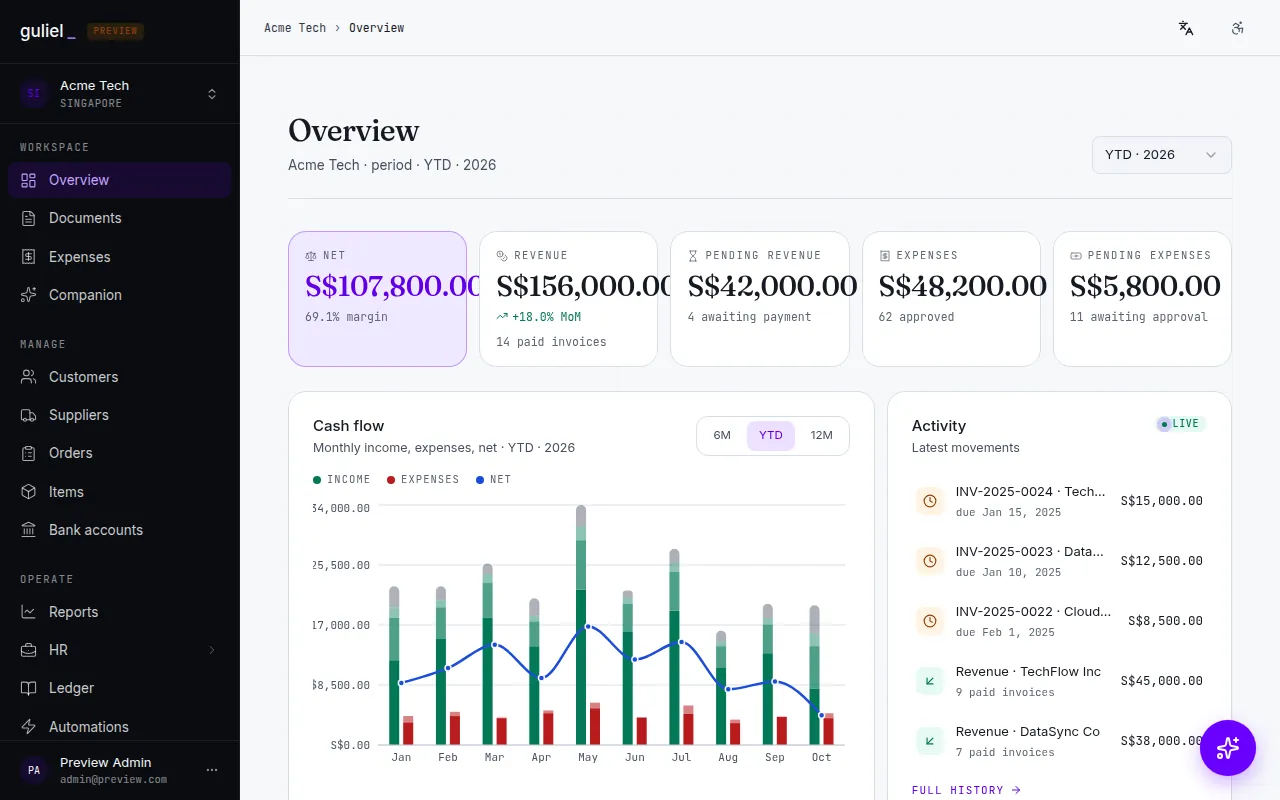
Guliel marks tax workflows, payments and open banking as coming soon. Peppol output for Guliel documents, direct document exchange between Guliel businesses, supplier discovery and B2B payments are planned. You can already try the real dashboard on sample data on Guliel's website.
Start free beside the tools you already use, and move over when you are ready. Paid plans are published and not on sale yet.