An AI support system has several decisions to make before anyone writes a reply: who should handle the request, how urgent it is, and whether it needs a person. Jev AI, released by TypeSafe AI in early access on September 15, 2026, is built for those decisions. Its arrival gives teams a new option for the small judgments that sit throughout an automated workflow. Read the launch announcement.
This article looks at the release, five practical use cases, and how to evaluate a first integration. It draws on public documentation and published evaluations; the workflow examples below are implementation ideas, not results from a DevShift deployment.
Jev vs LLMs: the benchmark picture
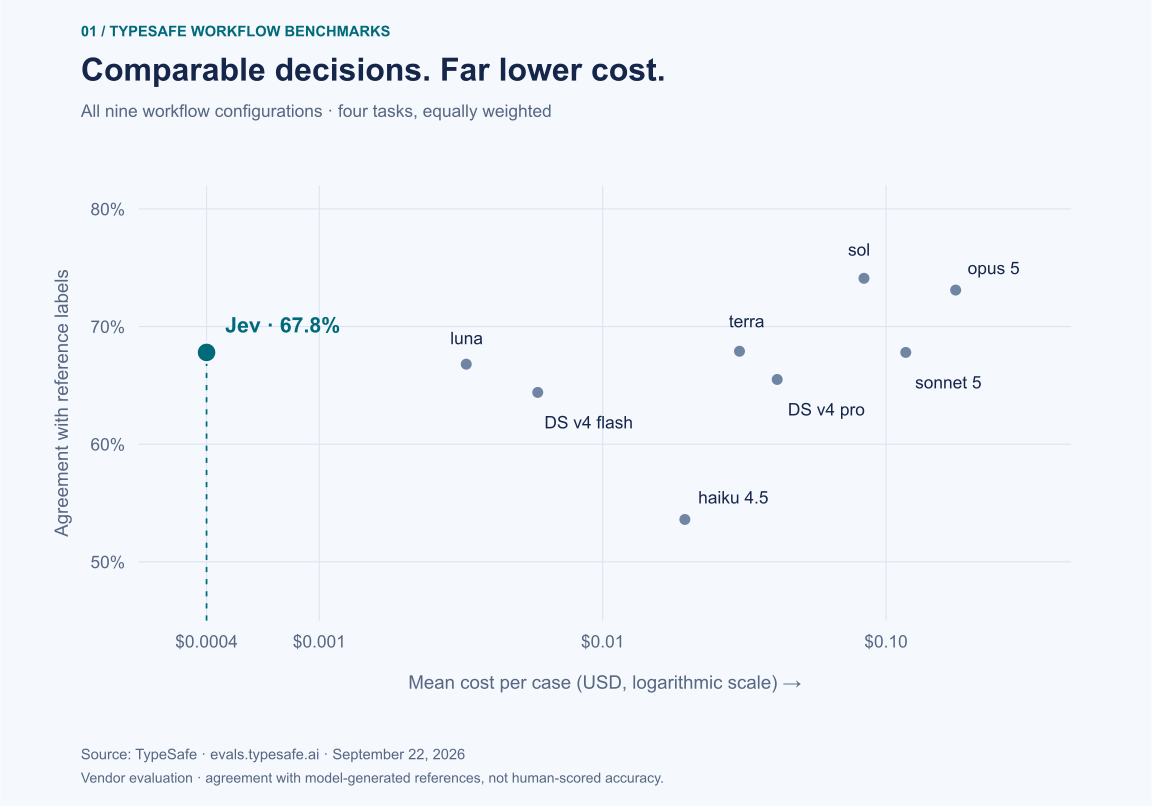
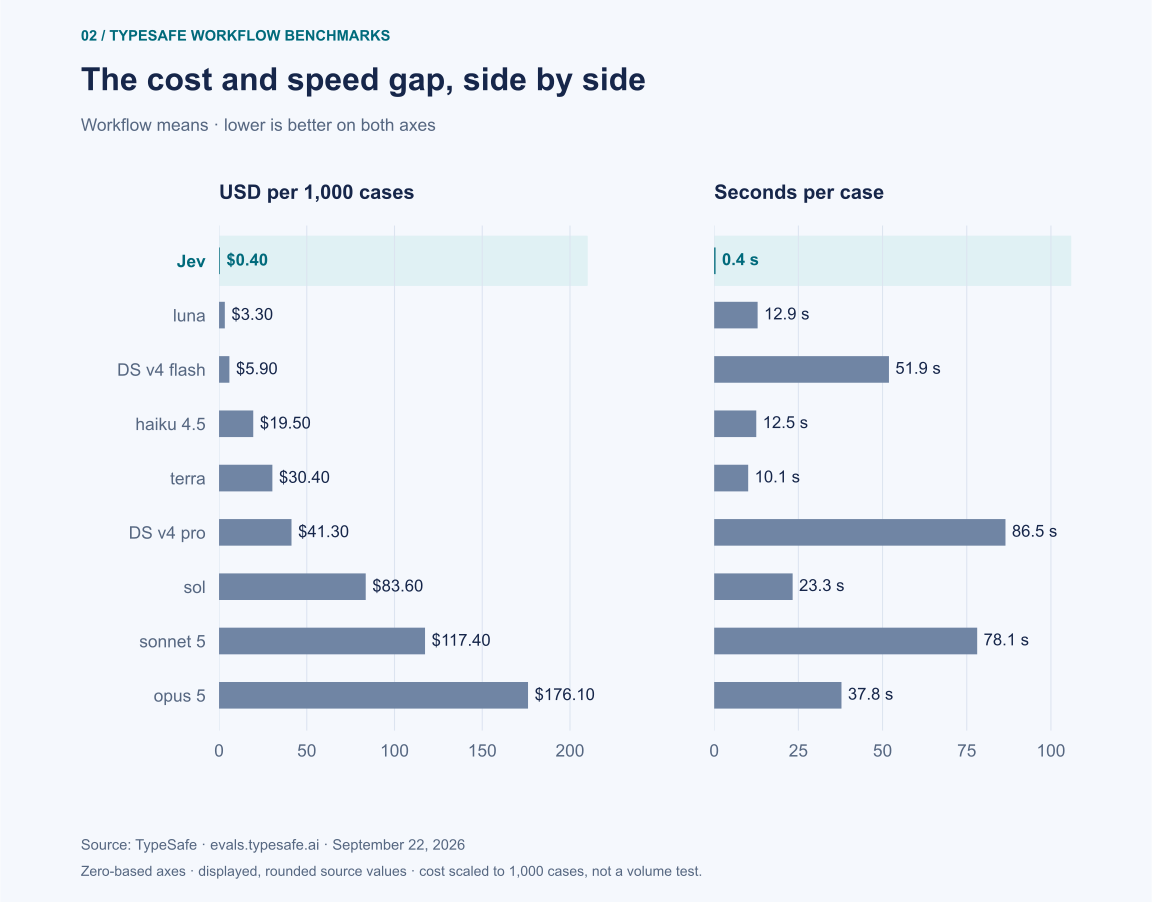
TypeSafe reports results up to 193.6× faster and 444.6× cheaper in its workflow evaluations. The charts below make that cost-and-speed advantage visible alongside the quality trade-off. These are the company’s results; TypeSafe describes those headline gains as the high end of real-world expectations. Read the launch methodology.
with reference answers
per workflow case
scaled to 1,000 cases
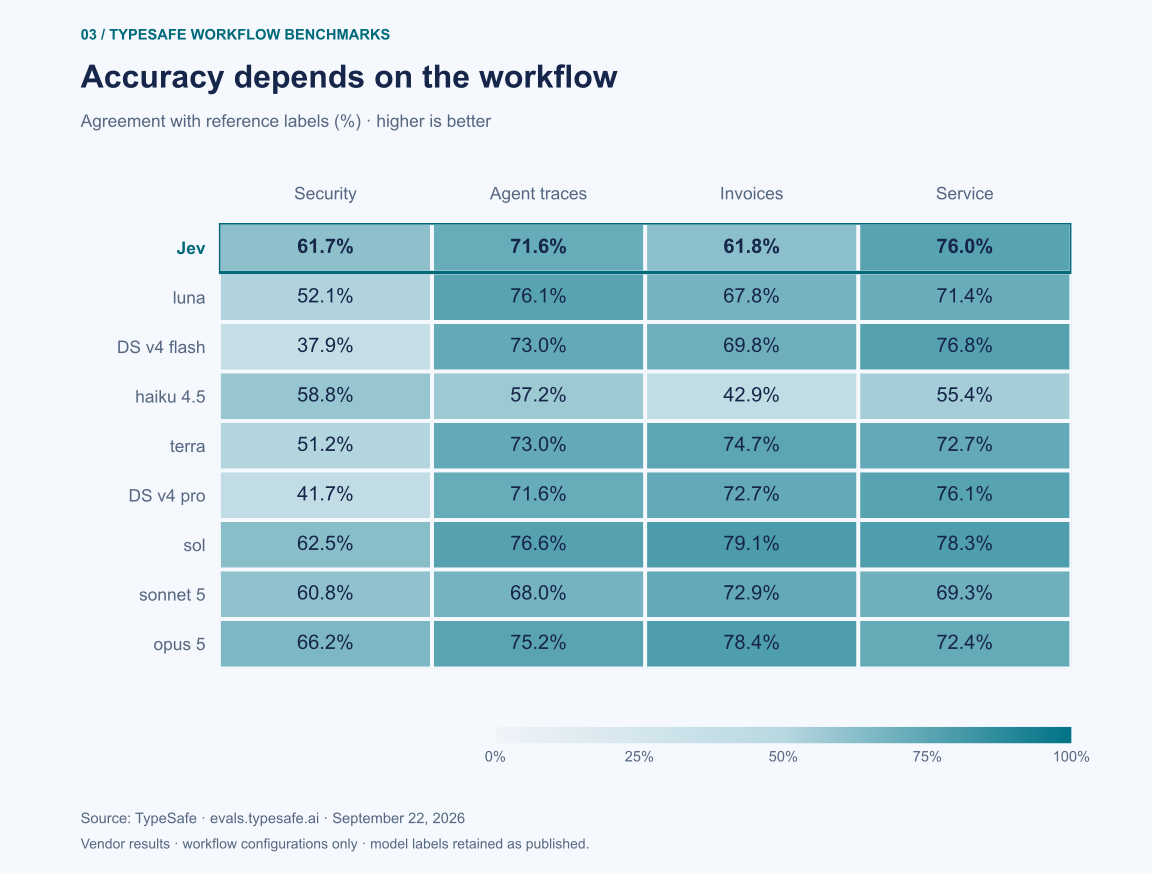
The published overview gives equal weight to four workflows: security incidents, agent trace review, invoices, and customer service. We chart all nine workflow configurations, using the site’s rounded display values and model names. “Accuracy” here means agreement with reference answers from GPT-6 Astra and Claude Fable 5.1 at high thinking; the tested models use their provider’s default reasoning settings.
View the benchmark data
| Model | Reference agreement | USD per case | Seconds per case |
|---|---|---|---|
| Jev | 67.8% | $0.0004 | 0.4 |
| luna | 66.8% | $0.0033 | 12.9 |
| DS v4 flash | 64.4% | $0.0059 | 51.9 |
| haiku 4.5 | 53.6% | $0.0195 | 12.5 |
| terra | 67.9% | $0.0304 | 10.1 |
| DS v4 pro | 65.5% | $0.0413 | 86.5 |
| sol | 74.1% | $0.0836 | 23.3 |
| sonnet 5 | 67.8% | $0.1174 | 78.1 |
| opus 5 | 73.1% | $0.1761 | 37.8 |
| Model | Security | Agent traces | Invoices | Customer service |
|---|---|---|---|---|
| Jev | 61.7% | 71.6% | 61.8% | 76.0% |
| luna | 52.1% | 76.1% | 67.8% | 71.4% |
| DS v4 flash | 37.9% | 73.0% | 69.8% | 76.8% |
| haiku 4.5 | 58.8% | 57.2% | 42.9% | 55.4% |
| terra | 51.2% | 73.0% | 74.7% | 72.7% |
| DS v4 pro | 41.7% | 71.6% | 72.7% | 76.1% |
| sol | 62.5% | 76.6% | 79.1% | 78.3% |
| sonnet 5 | 60.8% | 68.0% | 72.9% | 69.3% |
| opus 5 | 66.2% | 75.2% | 78.4% | 72.4% |
The practical trade-off: Jev matches sonnet 5’s mean reference agreement at 67.8%, while sol reaches 74.1%. The task breakdown matters: Jev scores 76.0% on customer service, but 61.8% on invoices. Our reading is that frequent classification and routing are promising pilot candidates; the workflow’s own error rate still decides whether the savings are useful.
Read the comparison in context. These are vendor-run workflow tests. The LLM wrapper also produces probabilities, which TypeSafe says can be slower and more expensive than returning a decision alone. The headline speedups use the underlying evaluation; they cannot be reconstructed exactly from these rounded chart values.
There is also an early external test. LangChain evaluated five fixed weather-agent responses, repeating the judgments 100 times per case. Jev averaged 0.44 seconds and $0.00035 per call and matched the human reviewer on all 500 repeated binary decisions. That is encouraging evidence for this narrow task. Five distinct responses cannot establish general accuracy across business workflows.
As checked on September 22, TypeSafe lists Jev 1.13 at $0.042 per million input tokens, with output tokens free. That is direct API pricing; check the route you actually use. For a project budget, include all the other work: retrieval, generation, retries, review, and integration. Current model details and pricing.
What Jev AI brings to software
TypeSafe calls Jev a System One model: you provide context, called the state, and define the questions your software needs answered. Jev returns typed results. An application can use them directly to select a route or trigger a review. TypeSafe describes its training approach as Reinforcement Learning for Calibrated Decisions, or RLCD, aimed at making probability estimates useful for automation. TypeSafe’s introduction explains this interface.
The API has three question types:
- Choice: select from options you define, such as billing, technical support, or sales. The answer includes the selected option, a probability distribution, and confidence.
- Score: assess something against an ordered rubric, such as customer frustration. It returns a numerical score, probabilities over the levels, and confidence.
- Noul: estimate the probability that a yes/no statement is true. This is a number between 0 and 1, not a Boolean and not a separate confidence field.
Several questions can be evaluated independently against the same state in one request. If one decision depends on another, your application still has to combine the answers or make a later call. This is a useful separation: the model interprets the input; your code defines what happens next.
Vercel added Jev to AI Gateway on September 16. LangChain published its integration guide the following day, and LangSmith added Jev as an evaluation judge on September 21. Those releases make it possible to explore Jev inside an existing agent stack.
Five practical use cases for Jev AI
1. Route support tickets and incoming messages
A useful first project is assigning incoming requests to a team. Ask separately about the subject, urgency, and whether the message contains enough information to proceed. TypeSafe’s quickstart uses support triage to demonstrate the three question types.
For example, a duplicate-charge complaint could go to billing, while an incomplete integration report goes to technical support for clarification. Keep the first rollout limited to suggested routing. Measure corrected assignments and missed urgent cases before allowing automatic changes. Jev supplies the classification; a person or a generative model can still write the response.
2. Choose the right model or specialist agent
A routine product lookup and a difficult debugging request do not need the same resources. Jev can classify the request and select from predefined handlers. LangChain demonstrates model routing and tool-risk checks in its Jev integration.
Our suggested starting point is a small set of routes with distinct responsibilities and an explicit fallback. Compare the total cost and completion rate with the existing approach. A cheap routing decision has little value if it repeatedly sends difficult work to a model that needs to retry.
3. Screen an agent’s proposed tool actions
Before an agent runs a command, a classifier can flag a proposed write, deletion, or action outside the requested task. LangChain’s experimental Auto Mode middleware illustrates a way to put Jev before tool execution.
Treat that judgment as an additional signal. Permissions, allowed actions, and required approvals belong in the application. A valid classification must never grant access the agent did not already have. For a pilot, compare Jev’s flags with reviewer decisions while the existing controls remain in force.
4. Filter documents before generating an answer
In a knowledge assistant, search can retrieve passages that mention the right topic without actually answering the question. TypeSafe publishes a cookbook for classifying retrieved passages before sending them to a model that writes the answer.
A procurement assistant could use this pattern to separate relevant supplier terms from unrelated boilerplate and flag conflicting evidence for review. Keep the source references attached so a reviewer can inspect the material. Jev’s current input is text; scanned documents need OCR or another extraction step first. This fits into a broader document intelligence workflow.
5. Evaluate agent responses at scale
Evaluation asks bounded questions too: did the response address the request, follow the required format, or leave an important issue unresolved? LangSmith’s Jev support makes these judgments available as structured feedback on agent runs.
Start with criteria that reviewers can label consistently. Compare Jev’s judgments with those labels and inspect disagreements. Keep exact checks, such as whether a required field exists, in code. Use a generative evaluator when a written explanation is part of the review.
Type safety still needs good judgment
A result can fit the schema and still be wrong. Choosing “billing” from an allowed list prevents an invented department name. It does not prove billing is the right destination.
TypeSafe’s published limitations for Jev 1.13 include unreliable arithmetic and date comparisons, sensitivity to irrelevant context, and vulnerability to adversarial text. Keep calculations and date logic in code, pass focused context, and test misleading inputs. Jev also does not generate the final email, explanation, or report.
Probability and confidence need separate treatment. For Choice and Score, confidence is derived from the distribution across answers; it is not an independent guarantee of correctness. Set thresholds using observed performance and the cost of an error. TypeSafe’s confidence guide describes how to route uncertain results to review.
TypeSafe reports its best accuracy in English. Evaluate Hebrew and mixed-language inputs separately. Pin the model version used to validate thresholds: jev-latest can change. See the language and versioning notes.
How we would start a Jev pilot
Choose one frequent, reversible decision that already consumes time. Ticket routing or document relevance is easier to evaluate than a broad request to “automate customer service.” Our recommended sequence:
- Build a labeled sample. Include ordinary cases, missing information, ambiguous requests, and examples in every language the product serves. Keep a separate set for the final evaluation.
- Define the decision. Write clear options and criteria. Include a way to handle insufficient evidence, and decide what the application should do when the model is uncertain.
- Run alongside the current workflow. Record suggestions without acting on them. Compare errors, latency, review volume, and total cost with the existing process.
- Enable a limited automatic path. Allow only the actions supported by the evaluation. Preserve a fallback for uncertain answers and API failures, and recheck performance after model changes.
The release makes a specific design option worth testing: use a dedicated decision model for repeated judgments inside a larger system. Success means fewer costly mistakes and less unnecessary work across the whole process. For teams exploring that fit, our AI development services cover the surrounding workflow and integration. Discuss your project with DevShift.
Sources and availability checked September 22, 2026. Prices, integrations, and model behavior may change. DevShift has not independently benchmarked Jev for this article.