If you only read the launch posts, the verdict looks simple: GPT-5.6 Sol beat Claude Fable 5. OpenAI reports a higher coding-agent score, fewer output tokens, shorter benchmark time, and a lower API price. After using both on real software work, our verdict at DevShift is more complicated: Sol has closed the model gap, but Codex has not yet closed Claude Code's orchestration gap.
Sol is an exceptional model, especially for research, investigation, and methodical technical analysis. But on complicated, multi-step tasks, it regularly spends more time than Fable, expands the scope, and keeps verifying long after the useful work should have ended. Claude Code with Ultracode still feels like the stronger system for turning one large objective into coordinated work that actually finishes.
A necessary disclaimer: this is not a controlled lab benchmark. It is a field report from building, debugging, researching, and shipping with both tools. We separate vendor data from our own experience below because the difference between them is the point.
That assessment comes from substantial usage: across two intensive weeks and many of our projects, we used more than 20 billion tokens combined on Fable and Sol. It is not a controlled benchmark, but it is enough exposure to see recurring workflow patterns rather than a one-off impression.
Claude Fable 5 vs GPT-5.6 Sol: the short verdict
Best at: complex implementation, long-running builds, parallel work, and keeping a large objective coherent.
Why: Claude Code's Ultracode and dynamic workflows provide a stronger orchestration layer around the model.
Weakness: premium API pricing, heavy token use in workflows, and a less seamless remote experience.
Best at: research, deep repository inspection, edge-case discovery, and working across desktop and mobile.
Why: Sol is methodical and the Codex app makes every active task easy to reach from another device.
Weakness: it can overengineer, widen scope, and spend too long validating its own work.
Our bottom line: Sol may be the benchmark winner, but Fable is still our workflow winner for difficult software delivery. Codex wins the app. Claude Code wins the orchestra.
What the benchmarks say - and what they do not
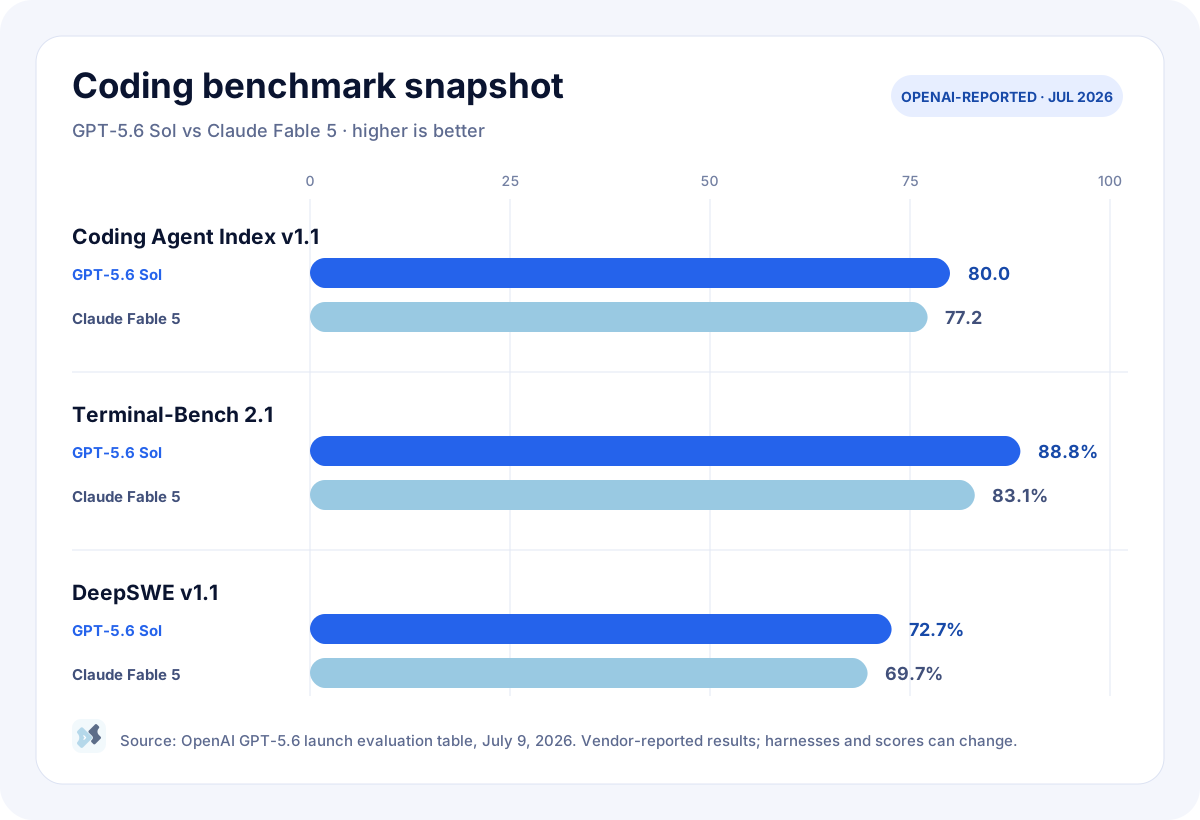
OpenAI reports that GPT-5.6 Sol scored 80 on the Artificial Analysis Coding Agent Index, 2.8 points above Fable 5, while using less than half the output tokens, taking less than half the time, and costing about one-third as much in that evaluation. At the model level, Sol's 1.05-million-token window is slightly larger than Fable's 1 million.
A significant product-level caveat: the underlying Sol model supports 1.05 million tokens, but the current Codex model catalog used in our tests exposes a 272,000-token window. Fable offers a 1-million-token window. That makes Claude's practical window roughly 3.7× larger. On repository-wide, long-running work, this is not a minor spec difference: Claude can retain far more code, logs, tool output, and prior decisions before compaction or context loss. In other words, Sol's model window is marginally larger on paper; Codex's window is much smaller in the product we tested.
The same OpenAI table reports Sol at 88.8% versus Fable's 83.1% on Terminal-Bench 2.1, and 72.7% versus 69.7% on DeepSWE v1.1. These are vendor-reported results, but the lead is consistent across the three coding evaluations OpenAI chose to publish.
The direct API price gap is real too. Sol is listed at $5 per million input tokens and $30 per million output tokens. Fable 5 is listed at $10 and $50. If your workload is high-volume and API cost dominates the decision, Sol starts with a meaningful advantage.
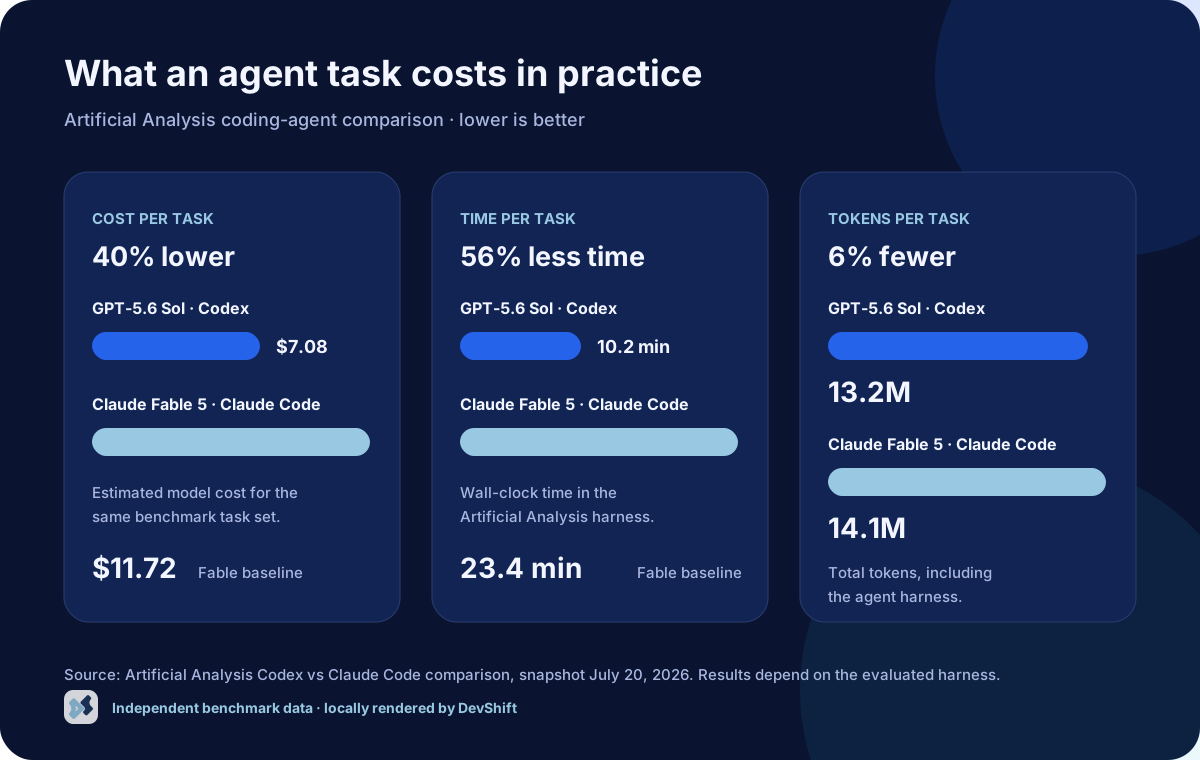
An independent Artificial Analysis comparison currently estimates $7.08 and 10.2 minutes per task for Sol in Codex, versus $11.72 and 23.4 minutes for Fable in Claude Code. That snapshot supports the efficiency case, although its wall-clock result differs from what we often see on our larger, messier project work.
But a coding benchmark measures a model inside a specific harness. Your day-to-day result also depends on how the product scopes work, delegates subtasks, preserves context, runs tools, stops at the right moment, and lets you intervene. That is why “which model is smarter?” and “which coding system helps us ship faster?” can produce different answers.
DevShift one-prompt test · July 20, 2026
We gave both systems the same landing-page brief
We launched Fable 5 and Sol simultaneously from the same commit in isolated worktrees. Both received the same brief: build a product page around one 3D object that transforms through the scroll, add no dependencies or remote assets, and continue through build, mobile, reduced-motion, and no-JavaScript validation. Claude Code ran Fable 5 at maximum effort; Codex ran Sol at Ultra reasoning effort. Both systems independently launched a code-review agent, and that child work is included in the time and token totals.
Claude Fable 5 + Claude Code
- Wall-clock time: 56m 16s
- Total transcript tokens: 19.61M
- Inserted lines: 2,854
A more modular 3D engine, with geometry, renderer, and lifecycle split apart. No critical or high findings remained after review fixes, but its live render loop is heavier and a direct stage link can leave the HUD one stage behind until scrolling continues.
Open the Fable pageGPT-5.6 Sol + Codex
- Wall-clock time: 28m 44s
- Total transcript tokens: 14.54M
- Inserted lines: 1,991
A smaller, more runtime-efficient implementation: bounds are cached, DPR is capped, and rendering stops when motion settles. The tradeoff is a renderer and lifecycle concentrated in one 766-line client component.
Open the Sol pageIn this controlled test, Sol finished in roughly half the time, used about 26% fewer tokens, and wrote about 30% less code. That is a clear result-and an honest counterexample to our broader field experience, where Fable usually finishes complex project work faster.
On code quality, both are serious outputs that passed lint, type checking, and a static production build. Fable wins on engine modularity; Sol wins on compactness and runtime discipline. Both systems independently launched a code-review agent, and that child work is included in the time and token totals.
In our visual review, Fable looked better. Its page felt more polished, cohesive, and impressive throughout the scroll-even though Sol won on time and efficiency.
Token totals include cached context and tool payloads, so they measure total processing rather than uncached API cost. Fable's time also includes a roughly three-minute handoff into Claude Remote Control. Both systems hit the same worktree Turbopack failure and solved it differently: Sol switched to the Webpack build flag, Fable ran a local pnpm install. This is one greenfield test, not a replacement for more than 20 billion tokens of field work.
Where GPT-5.6 Sol is genuinely excellent
Sol is the best research partner we have used from OpenAI so far. Give it an unfamiliar codebase, an incident trail, or a technical question with several competing explanations, and it is very good at exploring the branches before committing to an answer.
Research and evidence gathering
Sol is patient with sources, cross-checks claims, and notices contradictions. For architecture research, production investigations, or comparing implementation options, that methodical style is a real advantage.
Edge cases and hidden risk
It finds the permission boundary, migration risk, test gap, or adjacent failure mode that a faster agent may skip. On review work, we want that instinct.
Transparent, inspectable work
Codex makes terminal output, diffs, screenshots, tests, and approvals visible across the task. The app is built around supervising long-running engineering work, not just reading a final answer.
The Sol problem: it does not always know when to stop
The same caution that makes Sol a strong researcher can become friction during implementation. A focused fix grows into a broader cleanup. The cleanup triggers more tests. The tests reveal hypothetical risks. Soon the agent is designing safeguards for problems outside the original brief while the requested change is still not delivered.
This is our own observation, but we are not alone. In early Codex community reports, users have described the same overengineering pattern and longer wall-clock times on meaningful tasks. Those posts are anecdotes, not benchmarks, but they closely match what we see.
An independent one-prompt website test by Merge also found Fable finished faster and produced the more complete page, while Sol delivered a richer product story at a substantially lower generation cost. One small test proves nothing by itself. It does show why a single vendor chart should not end the conversation.
Thoroughness is valuable until it turns into scope expansion. Sol benefits from unusually explicit stop conditions: define the exact target, what is out of scope, the minimum validation required, and when to ask before widening the task.
Why Claude Code still leads at orchestration
Fable 5 is a formidable model on its own, but the bigger advantage is the system around it. Anthropic's dynamic workflows let Claude create a task-specific program, launch multiple agents in parallel, add checkpoints, verify outputs, and synthesize the result. The ultracode setting combines extra-high effort with permission for Claude to decide when that workflow is worth using.
That changes the shape of a large task. Instead of one agent serially researching, editing, testing, reconsidering, and repeating, Claude can split independent work, keep the main context focused on coordination, and bring results back together. Anthropic itself warns that dynamic workflows consume substantially more tokens. In our experience, they often consume less of the scarce resource that matters most: the operator's time.
On a repository-wide migration, a complex product feature, or a long investigation with several plausible causes, Claude Code feels more decisive about decomposition. Sol can reason deeply about every part; Claude more reliably turns the parts into a team.
The best of both worlds: Claude Code can call Codex
There is now an official bridge between the two: OpenAI's Codex plugin for Claude Code. One important correction to the shorthand is that the official plugin runs Codex from inside Claude Code; it does not make Codex the controller of Claude sessions. In practice, that is exactly the direction we want when Claude Code and Ultracode are the stronger orchestration layer.
With the plugin installed, we can keep a Claude-led dynamic or Ultracode workflow responsible for decomposition and coordination, then call Codex for a normal or adversarial review, delegate a bounded rescue task in the background, inspect its status and result, or transfer the current Claude session into a persistent Codex thread. This brings Sol's research and review strengths into a Claude-led workflow without manually copying the full context between tools.
Our hybrid pattern: Claude Code conducts; Codex challenges decisions, reviews the diff, or owns a clearly bounded subtask. It is still two runtimes with two usage budgets. The plugin documentation warns that its optional review gate can create a long Claude/Codex loop and drain limits quickly, so we supervise this setup rather than treating it as fire-and-forget automation.
Where Codex wins clearly: the app and device sync
This part is not close. Codex in the ChatGPT mobile app loads the live state of connected environments and keeps active threads, approvals, diffs, screenshots, test output, plugins, and project context synchronized. We can begin at a desk, continue from a phone, intervene during a long task, and return to the same state later.
Claude Code Remote Control can also expose a local session to the web or mobile app. By default, though, it is something you activate with claude remote-control, --rc, or /rc. Newer versions offer an “Enable Remote Control for all sessions” setting, which removes part of that friction, but the product still feels like a remote connection attached to a session. Codex feels like one workspace that happens to have several screens.
For anyone who moves between an office, a laptop, and a phone, this matters more than a few benchmark points. The best agent is often the one you can answer before it spends another hour going down the wrong branch.
Which one would we choose?
- For deep research or a production investigation: GPT-5.6 Sol. Its patience, source work, and appetite for edge cases are exactly what we want before deciding what to change.
- For a complicated, multi-step build: Claude Fable 5 in Claude Code. Ultracode's orchestration makes the whole system feel faster and more coherent, even when a benchmark says the underlying model is slower.
- For coding from anywhere: Codex. OpenAI's app and synchronization experience is the best product layer in this comparison.
- For the highest-stakes work: use both. Let Sol challenge assumptions and research the terrain; let Claude orchestrate the implementation; then cross-review the result.
- For the best integrated hybrid: Claude Code plus codex-plugin-cc. Keep Claude and Ultracode in charge of orchestration, while Codex handles adversarial review, research, or a bounded delegated task.
The gap is closing, but the winner is not just a model
Claude dominated agentic coding for a reason. GPT-5.6 Sol changes the balance: OpenAI now has a frontier model that can compete directly, beat Fable on a major coding index, and do it at a lower API price. Calling Codex “far behind” is no longer credible.
But software delivery is not a model leaderboard. It is model quality multiplied by orchestration, product design, context management, and the cost of human supervision. Today, our DevShift view is that Sol has closed the intelligence gap faster than Codex has closed the orchestration gap. Claude Code with Ultracode remains our first choice for the hardest long-running builds. Codex is our first choice for research and for staying connected to work from anywhere.
The same workflow-first rule applies to AI agents in business: choose the system around the model, not the logo on it. Our AI development approach starts with the process, constraints, and evidence.
Building a product or an AI workflow and unsure which stack fits it? Tell us what you are trying to ship. We will recommend the model, orchestration pattern, and engineering approach that fits the work - even when the answer is a hybrid.
Sources and further reading
- OpenAI: GPT-5.6 launch and benchmark results
- Anthropic: Claude Fable 5 launch
- Anthropic: Dynamic workflows and Ultracode
- OpenAI: Work with Codex from anywhere
- Claude Code: Remote Control documentation
- OpenAI: Codex plugin for Claude Code
- Artificial Analysis: Claude Code vs Codex benchmark comparison