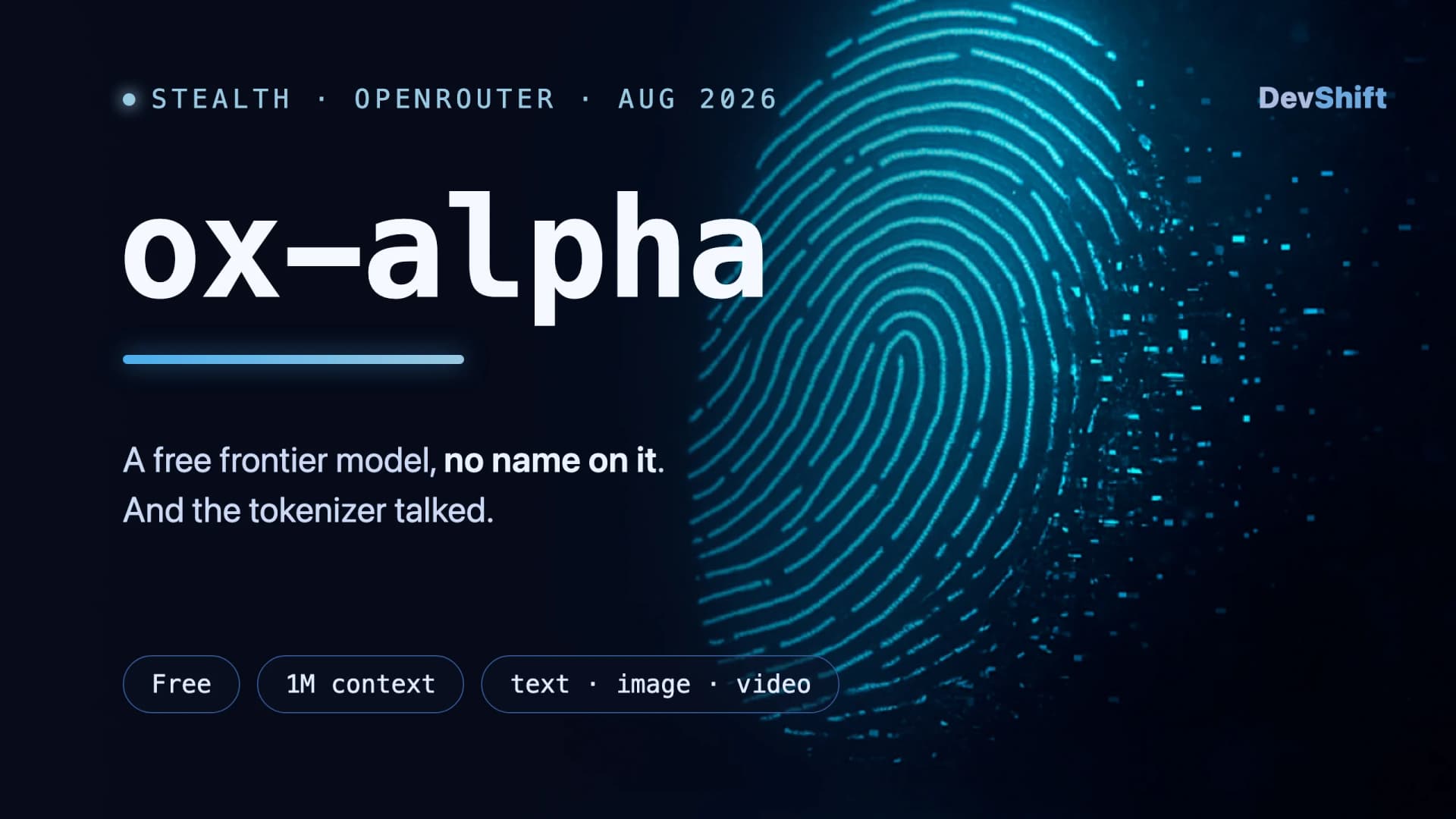
On 20 August 2026 a frontier-class AI model appeared on OpenRouter with no company name attached to it. It is called ox-alpha, it is free for about a week, it reads text, images and video - and at first nobody who built it would admit to it. We pointed it at a real production task the day it dropped. Here is what it is, what it can do, and who is behind it.
Update, 26 August 2026: Z.ai has named it. In the official GLM-5.3-Flash launch post, the lab wrote that it tested the model anonymously as ox-alpha on OpenCode and OpenRouter before the release. The fingerprints below had been pointing at the right family - the product name is GLM-5.3-Flash, a cheaper sibling of GLM-5.3, not GLM-5.3 itself. Weights are on Hugging Face under an MIT license.
What ox-alpha actually is
OpenRouter lists it under the provider name “Stealth” and calls it a reasoning model for coding, sustained agentic work and production workloads. In plain terms: a capable, general-purpose model aimed squarely at software engineering.
It went live on 20 August 2026, and the OpenCode team ran a parallel promotion putting it at zero cost for the following week, with rate limits generous enough that they called it “near-unlimited.” The unusual part is the data policy: the provider states that prompts and completions are not used for training - OpenCode calls it zero data retention - which is rare for a stealth release. You can reach it right now through the OpenRouter API or playground, or through OpenCode in a terminal, under the model ID stealth/ox-alpha.
Try it while it’s free: the model lives at openrouter.ai/stealth/ox-alpha. The free window opened on 20 August 2026 and was set to run about a week; pricing after that has not been announced.
So who made it?
When we first published, nobody had confirmed anything. Two labs kept coming up - and one of them had the receipts.
A developer known as dax ran a tokenizer test across 25 prompts; ox-alpha’s token counts matched Z.ai’s GLM-5.3 exactly, off by a constant 75-token wrapper each time. A separate analysis matched ox-alpha’s full OpenRouter API contract - seven fields at once - to GLM-5.3 alone out of more than 400 models. Z.ai has been pushing GLM toward vision, which fits ox-alpha’s image and video support.
Xiaomi’s MiMo team has done exactly this before: MiMo-V2-Pro ran on OpenRouter as “Hunter Alpha” before Xiaomi claimed it at launch. ox-alpha’s spec sheet - a million-token context, native multimodality, an obvious lean toward agentic coding - matches the shape of what Xiaomi has been shipping.
The tokenizer and API-contract matches are real, reproducible measurements, and they prove shared lineage - almost certainly the GLM 5 generation. They did not, by themselves, prove ox-alpha was literally GLM-5.3. After this article first ran, Z.ai confirmed the model as GLM-5.3-Flash. One more clue had already pointed the same way: ox-alpha trips on the same “dirty token” that has previously snagged Qwen and GLM-family models.
We tested it the day it dropped
Speculation is cheap, so we ran ox-alpha against real work. We handed it - and Anthropic’s Claude Fable 5 - the identical brief for a secure, multi-tenant incident-intake app: specification first, then implementation, then a security review. Afterwards we attacked what each one built.
ox-alpha was fast and startlingly cheap: it finished in about an hour on roughly a fifth of the tokens, and produced a correct, readable application. But its isolation between customer organizations was a convention rather than a mechanism - one forgotten predicate would leak silently, a gap its own security notes admit - it wrote no tests, and its interface needed a manual reload after every change. Fable did the slower, more expensive, more thorough job. On a security build, that difference is the whole game.
See the full head-to-head: the exact prompt, the metrics, the screenshots and the scores are on our secure multi-tenant build benchmark, and everything we know about the model - including the identity evidence - sits on the ox-alpha model page.
Why a free stealth model shows up at all
ox-alpha did not appear in a vacuum. Over the past year the share of tokens processed by US models on OpenRouter has fallen from around 70% to roughly 30%, with Chinese labs - DeepSeek, Tencent, Xiaomi, Z.ai - taking the rest. A free, high-context, multimodal stealth drop is exactly the move that accelerates that shift: developers get a frontier-class model at no cost, and whichever lab is behind it collects a week of real-world usage data before it has to attach a price or a name.
Quick answers
Is ox-alpha free?
Yes, during the preview window that opened on 20 August 2026 - OpenCode put it at $0 for about a week with generous limits. Pricing after the window has not been announced.
What is ox-alpha?
The OpenRouter stealth preview of Z.ai’s GLM-5.3-Flash: a reasoning model built for coding and agentic work, with a ~1M-token context and text, image and video input.
Is ox-alpha GLM-5.3?
Yes - specifically GLM-5.3-Flash, confirmed by Z.ai on 26 August 2026. The tokenizer and API fingerprints already pointed at that family; the official name is the flash-tier sibling of GLM-5.3, not GLM-5.3 itself.
Is it safe to send it real prompts?
The provider states prompts and completions are not used for training. As with any third-party endpoint, don’t send secrets - but by the stated policy this one is unusually clean for a stealth release.
Weighing a new model for real work? That is most of what we do - we put frontier models through actual production tasks before we trust them with client code. If you are deciding what to build on, let’s talk.