The shortest honest summary of Grok 4.6 is this: it did not win every chart. It did something that may matter more. It pushed the price of frontier intelligence down to what used to look like a mid-tier model price.
Grok 4.6 launched on August 12, 2026, jointly developed by Cursor and SpaceXAI. On Artificial Analysis' independent index it is effectively tied with GPT-5.6 Sol and just behind Claude Fable 5, yet its standard list price is $2 per million input tokens and $6 per million output tokens. That is not another incremental benchmark release. It is a direct attack on the economics of the frontier-model market.
The number that makes this launch unusual
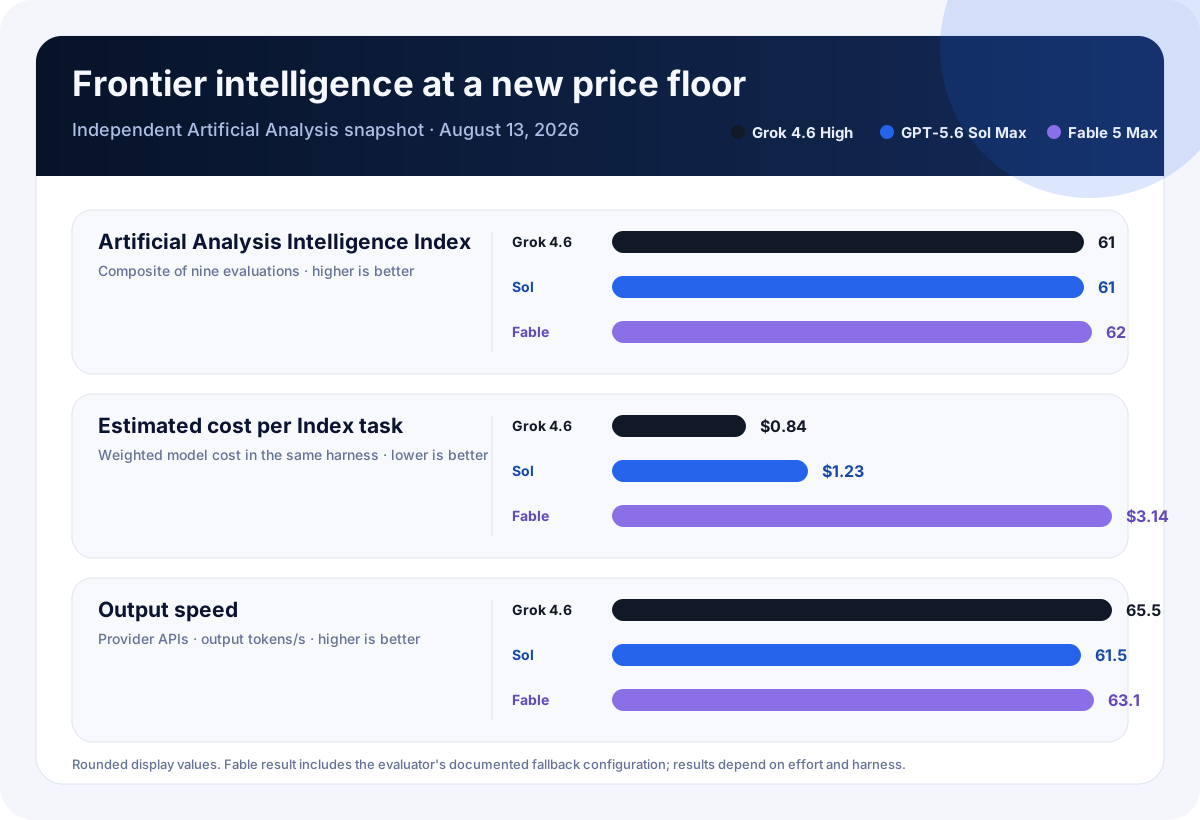
In Artificial Analysis' August 13 snapshot, Grok 4.6 High scored 60.923. GPT-5.6 Sol Max scored 60.930. That difference is too small to carry a serious narrative; both round to 61. Fable 5 Max sits one rounded point higher at 62.
The meaningful separation is on cost. Artificial Analysis estimates $0.84 of model cost per Intelligence Index task for Grok, versus $1.23 for Sol and $3.14 for Fable. In the same measurement harness, Grok is therefore about 32% cheaper per task than Sol and 73% cheaper than Fable.
The same rounded index score, with Grok's API priced 60% lower on input and 80% lower on output: $2/$6 versus $5/$30.
One rounded index point behind, with input 80% cheaper and output 88% cheaper: $2/$6 versus $10/$50.
Token price and task price are not the same thing. A cheap model that writes four times as many tokens may still cost more at the finish line. Here, however, both views point in the same direction: the API rate and the measured task cost put Grok at a new price floor for this level of intelligence.
But the $2/$6 headline has footnotes
SpaceXAI's pricing documentation lists $0.50 cached input, $2 input, and $6 output per million tokens for prompts below 200,000 tokens. Once a prompt reaches 200,000 tokens, the entire request moves to doubled long-context rates: $1, $4, and $12. Priority processing also costs twice the standard rate, while web search, X search, code execution, file search, and collections carry additional charges.
Cursor lists the standard model at the same $2/$6 rate and its Fast tier at $4/$12. The launch week's “2x included usage” is temporary. Context also depends on where you run it: SpaceXAI's API exposes 500,000 tokens, while Cursor serves a 256,000-token context. A real cost comparison must use the route where the workload will run, not the largest number in the announcement.
Is Grok 4.6 actually fast?
Yes, relative to the direct frontier peers in this comparison—but not in the sense of instant response. Artificial Analysis measured 65.5 output tokens per second, versus 61.5 for Sol and 63.1 for Fable. That is a useful advantage once generation begins.
On the other hand, 65.5 tokens per second is roughly around the site's comparison median, and time to first answer token measured 31.18 seconds. There was also no independent Fast-tier measurement available at publication time. The precise claim is: Grok generates slightly faster than these direct peers and is exceptionally economical per completed task. Calling it universally “insanely fast” would turn analysis into hype.
The benchmarks: near the frontier, with visible holes
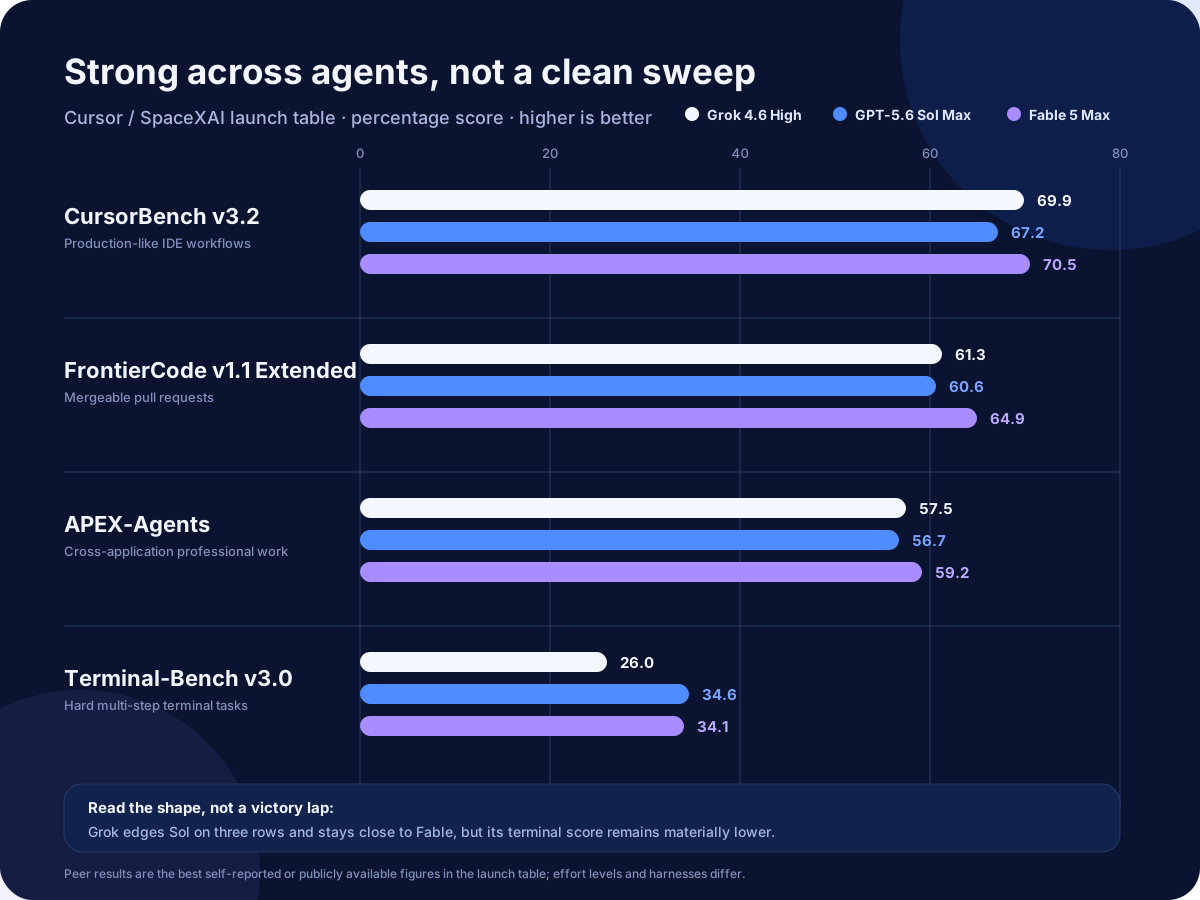
Cursor and SpaceXAI's launch table is impressive. Grok 4.6 High scores 69.9% on CursorBench 3.2, against 67.2% for Sol Max and 70.5% for Fable Max. It edges Sol on FrontierCode and APEX-Agents, and reaches 1,753 on GDPVal-AA v2—higher than both Sol and Fable in the launch table.
This is not a victory lap. On DeepSWE 1.1, Grok scores 65.9%, versus 73% for Sol and 70% for Fable. Terminal-Bench 3.0 is a clearer weakness: 26% for Grok, against 34.6% and 34.1%. On SWE-Marathon it reaches only 31.9%, well behind the leading results. Grok is shown at High effort while peers are generally shown at Max, and the peer rows use the best self-reported or public results collected for launch rather than one perfectly uniform run.
The most tempting number is on the live CursorBench leaderboard: Grok 4.6 xhigh scores 70.8% at an average $2.81 per task, versus 70.5% and $17.32 for Fable 5 Max. That makes Grok roughly 84% cheaper on this benchmark while scoring slightly higher. Cursor also co-developed the model and owns the benchmark, so this must be labeled as Cursor-reported evidence, not an independent result.
The official model card suggests unusual strength in engineering and CAD as well: 60 on EEBench at xhigh versus 39.4 for Sol, and 40.9 on CadGen versus 37.1. Those are signs that Grok is more than a cheap coding model, but they remain vendor launch results rather than our own verification.
So what is genuinely groundbreaking?
It is not simply that another model landed near the top. That now happens with remarkable frequency. The change is that a frontier-level model arrives at a price that lets teams use it differently.
More attempts before the budget runs out
Long coding and research agents consume millions of tokens across failed branches, tool calls, retries, and review. A sharp price cut buys more parallel attempts, another critic pass, and a fallback without turning every run into a budget decision.
A frontier model as the default
Many organizations reserve their strongest model for escalations. If Grok's quality survives production workloads, it can move from exception handling to the default engine behind an entire workflow.
Price pressure on the whole market
When a score of 61 sells for $2/$6, premium competitors must justify the markup through quality, context, latency, safety, or a better product. Teams that never adopt Grok may still benefit from that pressure.
That is why this release deserves the word groundbreaking without declaring Grok “the world's best model.” It does not win every task. It changes the price at which teams can make a serious attempt to win one.
Then Grok Bot arrived one day earlier
Grok Bot launched in beta on August 11 as a persistent cloud teammate: it can sign into tools, work in the background, and continue after the user's computer goes offline. Initial access runs through desktop and iOS for SuperGrok Heavy, Cursor Ultra, and Cursor Teams Premium subscribers.
The Cursor overlap is real, but precision matters. A regular Cursor subscription does not automatically equal a Grok subscription, and the plans remain separately priced and billed. Only specific premium tiers currently cross-entitle Grok Bot. There is no announced universal account, unified billing system, or reciprocal access to every product.
There is an operational question too. An agent that signs into tools and works in the background needs least-privilege access, audit logs, spending limits, and approval points. Cheap inference can make the agent economical; it does not make autonomous access safe by default.
Cursor and SpaceXAI are not merely “getting closer”—there is a signed deal
The natural theory is that Grok Bot hints at a future Cursor/xAI merger. Reality has already moved beyond that theory. According to SpaceX's SEC Form 8-K, SpaceX, a merger subsidiary, and Anysphere—the company behind Cursor—signed a definitive merger agreement on June 16, 2026, at an implied $60 billion equity value. If completed, Cursor would survive as a wholly owned SpaceX subsidiary. The latest August 4 quarterly filing still described the transaction as pending regulatory and other closing conditions.
Because SpaceX acquired xAI in February 2026, the emerging structure brings three layers under one group: SpaceX capital and compute, SpaceXAI models, and Cursor's development environment and distribution. Grok Bot is not proof that the transaction will close. It does look like an early product expression of the integration the companies are already building.
The fact: a merger agreement is signed, Grok 4.6 was jointly developed, and selected Cursor premium plans include Grok Bot. Our interpretation: the products are moving toward one integrated system. There is still no single subscription, and the deal had not been reported closed at publication time.
The data loop may become the bigger advantage
In April, Cursor said it was using SpaceXAI's Colossus for model training. The Grok 4.6 model card says supplemental training incorporated anonymized Cursor workflow data. The resulting model is now distributed back through Cursor and Grok Bot.
This is analysis, not a company promise: if the loop works as intended, Cursor supplies real-world tasks, SpaceXAI supplies compute and a low-cost model, and the product returns improvements to users and workflows. The competitive advantage is no longer only who owns the most GPUs. It is who owns the shortest feedback loop between real usage, training, and distribution.
What we would do now as builders and product leaders
- Test representative work. Run 20–50 real tasks, including failures, and do not select a model from one aggregate index.
- Measure cost per completed task. Include tokens, tool calls, retries, wall-clock time, and human review—not just the rate card.
- Start with standard speed. Fast doubles the price and still lacks independent latency evidence. Use it only where waiting costs more than the premium.
- Keep a fallback route. Grok can be the economical default while Sol or Fable receives categories where internal tests prove an advantage.
- Treat Grok Bot as a privileged system. Separate environments, constrain access and spend, and keep human approval for irreversible actions.
The verdict: an economic breakthrough, not a universal win
Grok 4.6 is one of 2026's most consequential launches because it breaks the old link between “almost the smartest model” and “extreme premium pricing.” It nearly ties Sol on an independent index, sits just behind Fable, generates slightly faster than both—and costs dramatically less.
It is still weaker on several coding and agent benchmarks, its initial latency is not low, Cursor exposes less context than the raw API, and long-context or Fast requests double the headline price. Those are not footnotes to ignore; they are how teams use the model correctly.
At the same time, Grok Bot's Cursor Ultra entitlement shows where the product is heading. Not toward a unified subscription that already exists, but toward an integrated stack of model, development environment, and cloud agent—around a merger agreement that is signed and still awaiting completion. If that integration works, Grok 4.6's price will be only the first part of the story.
This continues the argument in our Claude Fable 5 versus GPT-5.6 Sol analysis: choose the system that fits the work, not a logo. If you are building an AI product or workflow, tell us what you need to ship—we will benchmark the models and economics against your tasks.